Edition and Source Note
A designed public-facing edition of a source-grounded first-person legal history.
This booklet keeps the essay’s archival argument intact while giving it a calmer public reading surface: citations moved to endnotes, documentary artifacts curated, and the interior redesigned for sustained reading rather than file review.
The argument remains tied to the Judicial Papers of Alexander Francis Ball. Design changes in this edition are editorial and presentational, not archival.
Contents
From institutional background to governance conflict, metrics, territorial legitimacy, and historical afterlife.
Introduction
Introduces the dispute as a struggle over who could describe the court accurately enough to restructure it.
When people speak of judicial politics, they usually imagine the wrong setting. They imagine appellate courts, constitutional showdowns, confirmation battles, or openly ideological conflict. They do not imagine memoranda about parking-garage data. They do not imagine bench-meeting notes on calendar design. They do not imagine draft maps, judicial productivity credits, or arguments about whether a remote hearing counts as real judicial work. Yet one of the clearest lessons of my term as Justice of the Peace for Pima County Justice Precinct 6 is that the political life of courts often appears most sharply in precisely those administrative forms. In a high-volume local court, particularly one that is both territorially organized and administratively consolidated, the politics of the judiciary may take place less through direct interference with particular rulings than through contests over structure, measurement, supervision, and institutional voice.
That is what happened in Pima County during the re-precincting controversy that emerged in 2021 and shadowed the years that followed. County administration proposed eliminating one of the justice precincts within the Pima County Consolidated Justice Court, redrawing the boundaries of the remaining precincts, and effectively redefining the territorial structure through which local justice was publicly authorized. The proposal was defended in the language of efficiency, long-run filing decline, judicial productivity credits, election-cycle timing, and statutory authority. In that language, the matter appeared technical. It concerned data, demography, and administration. But from inside chambers it did not feel technical in that narrow sense. It felt constitutional, institutional, and democratic. It felt like a dispute about who could describe the court truthfully enough to restructure it. It felt like a dispute about whether local judicial office could be redescribed through managerial categories that captured only the most visible fraction of judicial labor. And it felt like a dispute about whether the elected justice of the peace remained a meaningful territorial and public office within a court that had long since become centralized for many of its administrative functions.
I do not mean to romanticize the controversy. County administration had real reasons for concern. Filings had declined over time. Judicial productivity credits were below the statutory ceiling that triggers mandatory expansion. The consolidated court used hearing officers and a judge pro tempore to hear some matters that, in other settings, might be handled directly by elected judges. Election deadlines and Voting Rights Act constraints imposed real timing and mapping pressures. If one reads only the official county memoranda, the proposal can appear not only plausible but prudent. To say that is not to concede the dispute. It is to begin honestly.
But I could not accept the county’s public description of the court as adequate to the gravity of what it proposed. My memoranda, testimony, and later reports show that I did not object simply because a change was under consideration. In fact, I wrote in July 2021 that I was “open to exploring” whether the court could fulfill its mission with a reduced number of judicial officers. My objection was narrower and deeper. I believed the county’s metrics were incomplete, that their sequencing in the public record was unfair, that the proposals did not meaningfully reflect the judiciary’s interests, that the court had not been heard early enough or seriously enough, and that the public was being invited to evaluate the office through categories too thin to bear the constitutional and civic weight being placed upon them.1
That experience changed how I understood local judicial politics. It clarified for me that judicial independence in a lower court cannot be reduced to freedom in case adjudication, important as that freedom is. Later in my Farewell Address, I stated plainly that no one at the court attempted to interfere with my judicial independence in the decisional sense. In every case, I wrote, I remained free to enter judgment according to law. I meant that. Yet the re-precincting dispute also taught me that a judge can retain decisional freedom while still confronting structural pressures with constitutional significance. A court can remain independent in one sense while becoming vulnerable in another. The office can be left free to decide cases while being described, measured, administered, and politically situated in ways that narrow its practical voice and alter the terms of its public legitimacy.2
This essay is an attempt to tell that story from within, but not as an exercise in unrestrained memoir. I write here in the first person because the surviving record already contains my memoranda, testimony, reports, and later reflections in the first person, and because the episode is best understood in part as a struggle over how the court was seen from inside chambers versus how it was translated into public administrative categories. Yet I also write as carefully as I can as a scholar of the episode. I do not take every later recollection as fact merely because it is mine. I distinguish contemporary documentation from retrospective interpretation. I reconstruct the county’s case as fairly as I can from the official public memoranda. And I place the dispute within Arizona’s constitutional and administrative structure because only then can the local politics of the matter be properly understood.
My central claim is straightforward. The re-precincting controversy in Pima County was not only a dispute about lines on a map. It was a dispute about the political life of court structure in a local judicial system that combined territorial election with centralized administration. The county’s case was managerial, statutory, and data-driven. My case was institutional, constitutional, and civic. The conflict that resulted was not a side-show to the administration of justice. It was itself part of the administration of justice, because it raised the question of whether the office of a justice of the peace could be truthfully represented, responsibly measured, and publicly restructured without misunderstanding what local judging actually consists of.
A Note on Voice and Method
Because this essay is written in the first person, I should be explicit about what kind of first-person account it is. It is not a fictionalized interior monologue and it is not a free-standing personal reminiscence unconstrained by the archive. It is a source-based retrospective essay written from my perspective using the materials that preserve that perspective most directly: my memoranda, testimony, county-facing correspondence, reports, and later reflections, together with the bench-meeting notes, training documents, chambers spreadsheets, and official public materials that reveal the institutional setting in which I acted.
The primary source base is the preserved corpus under . The most important internal documents for the purposes of this essay are: Memos/Memo on Administration.docx; Testimony to the Pima County Board of Supervisors.docx; the April 23 and June 28, 2021 bench-meeting notes; the county-admin-facing documents in Final GDrive Docs/[05] Memos/Memo to County Admin; the judicial-training document History of the Pima County Consolidated Justice Court.docx; later reflective materials including Farewell Address.pdf, Myers Report.pdf, and Reporters/END OF TERM REPORT.docx; and the 2022 chambers spreadsheets that illustrate the multidimensional nature of court workload even if they postdate the initial dispute. I do not treat those later materials as unfiltered proof of 2021 facts. I use them as evidence of how the structural issue continued to appear from my vantage point and from within the institution’s longer arc.
I also rely on official external sources where necessary, because the controversy cannot be understood from my papers alone. The relevant legal background includes the Arizona Constitution, particularly Article VI, sections 1 and 3; Arizona Revised Statutes sections 22-101, 22-102, and 22-125; and the key Arizona Supreme Court administrative orders governing the Pima County Consolidated Justice Court, especially 2013-70, 2020-115, 2020-189, 2021-105, 2024-153, and 2024-220.3
The official public county record matters as well. The key external county documents are C.H. Huckelberry’s July 27, 2021 memorandum responding to Judge Taylor and me; his July 30, 2021 memorandum laying out the re-precincting process and draft maps; and his September 21, 2021 memorandum recommending action on the elimination of JP5 and related precinct changes.4
I use a small amount of scholarship only to sharpen distinctions already visible in the archive. In particular, federal judicial-administration scholarship is useful in distinguishing decisional independence from administrative and procedural independence. That distinction helps explain why, from my perspective, the re-precincting controversy felt profound even though I later made clear that no one ever attempted to dictate how I should decide a case. The conceptual frame is helpful, but the argument of this essay remains grounded in the preserved local record.5
Two limitations should be kept in view throughout. First, my papers preserve my side and the judicial side more fully than they preserve every internal county communication or every participant’s point of view. The official county memoranda help remedy that imbalance, but they do not eliminate it. Second, later retrospective documents, including my Farewell Address and Myers Report, are important not because they settle every factual question, but because they reveal how I later understood the structural stakes of the controversy. Where I rely on those later materials, I say so openly.
The Non-Record Court and the Burden of Public Explanation
Shows why justice courts are historically vulnerable to misdescription and why participant archives matter so much here.
One reason the re-precincting dispute became so consequential to me is that justice courts are unusually vulnerable to public misdescription. They do not usually leave behind the kind of formal jurisprudential trail that allows outsiders to reconstruct their internal life by reading published opinions. Much of what a justice court does is dispersed across calendaring, intake, warrant practice, civil processing, misdemeanor adjudication, protective-order work, remote appearances, chambers review, and constant adjustment between clerks, litigants, lawyers, and judicial officers. A court of this sort may be immensely active while remaining difficult to narrate from the outside. That difficulty is not incidental. It is one of the defining historical conditions of lower-court life.
For that reason, the problem of public explanation in a non-record court is never merely academic. When a county administrator, a board, or even a well-intentioned public observer asks whether such a court is overbuilt, underused, or in need of structural redesign, the answer will depend heavily on what kinds of work can be seen and what kinds disappear. Visible hearings, posted calendars, filing totals, building-access logs, and parking-garage entries travel well in public debate because they are countable and communicable. Chambers review, judicial preparation, collaborative coverage, administrative troubleshooting, remote-hearing adaptation, and the cumulative burden of keeping a high-volume court coherent do not travel as easily. The risk is therefore systematic. The non-record court can be redescribed by the very categories most convenient to outside governance.
That risk helps explain why I turned so quickly to memoranda. In an appellate court, a judge may defend an institutional vision partly through opinions whose permanence is built into the system. In a justice court, especially a consolidated one, the memo, testimony statement, training document, bench note, and later report may become the place where institutional truth is preserved. Those genres are humbler than reported cases, but they can be historically more revealing. They show how judges and administrators understood the office while its structure was still unsettled. They also reveal how deeply the politics of a lower court may be carried in documents that look, at first glance, merely administrative.
I therefore write this episode as both participant and historian of a non-record institution. That dual posture is not a literary flourish. It is forced by the archive itself. If one wants to understand the political life of a local justice court, one must often reconstruct it from the places where the institution tried to explain itself before others explained it for it. In Pima County, that is exactly what happened. The dispute over re-precincting was also a dispute over who would author the intelligible public description of the court.
Entering Office Inside a Court Already Shaped by Consolidation
Sets the structural background: consolidation, superior-court supervision, the 2020 rupture, and the political setting of arrival.
I did not enter office on January 1, 2021 into a blank institutional field. I entered a court already shaped by decades of consolidation, delegation, and administrative refinement. That fact matters because the re-precincting dispute cannot be understood as if it arose in a conventional county with wholly separate local justice courts. Pima County was and is different. The political life of re-precincting in Pima County inhered in the tension between two institutional truths that had coexisted uneasily for years: first, the justice of the peace remained a territorial, elected, precinct-based constitutional office; second, the Pima County Consolidated Justice Court had long operated as a centrally administered court in which many of the most important managerial functions no longer tracked precinct boundaries in any simple way.
The court’s own internal training history captured that duality well. The document titled History of the Pima County Consolidated Justice Court, dated September 21, 2020, recounts that on February 22, 1974, the Arizona Supreme Court established centralized administration of the Tucson-area justice courts under the presiding judge of the superior court. It explains that later orders and practices continued that arrangement, producing what became the Pima County Consolidated Justice Court, with Ajo and Green Valley operating separately. The same document also notes that justice of the peace jurisdiction remained tied to precincts under the Arizona Constitution and Arizona statutes. In other words, the court was at once territorial and centralized. It lived in both registers at the same time.6
The formal legal sources show the same pattern. Article VI, section 1 of the Arizona Constitution vests the judicial power in “an integrated judicial department.” Article VI, section 3 gives the Arizona Supreme Court administrative supervision over all the courts of the state. At the same time, A.R.S. section 22-101 authorizes the Board of Supervisors to divide the county into justice precincts, change them, abolish them, or redistrict the county, while providing that abolition does not take effect until the term of the justice and constable then in office expires. A.R.S. section 22-102 provides that the officers of justice precincts are a justice of the peace and a constable elected by the qualified electors of the precinct. A.R.S. section 22-125 creates the regime of judicial productivity credits that helps determine compensation and, when credits exceed 1,200, requires the Board to create sufficient courts or redraw precincts.7
That framework alone would have been enough to make re-precincting politically sensitive. But the timing of my entry made the situation more complicated still. Administrative Order 2020-115, issued in July 2020, responded to a vacancy in the justice court administrator position by designating Presiding Judge Kyle Bryson of the Superior Court to supervise the day-to-day operations of the PCCJC, including the duties of the administrative judge, until further order. The same order appointed an interim justice court administrator with full authority over administrative matters of the PCCJC and specifically directed Bryson and Kent Batty to report to the Chief Justice on governance changes that might improve the existing structure. In short, by the time I took office, the administrative structure of the court was not only centralized. It was actively under review.8
The court’s own internal history is even plainer about why AO 2020-115 mattered. It records that the court administrator resigned after a majority of the justices of the peace voted “no confidence” in her abilities, and it links that rupture directly to the Chief Justice’s decision to install interim administrative leadership and require a governance report. From inside the court, that moment was not remembered as routine personnel turnover. It was remembered as the event that triggered a more visible Arizona Supreme Court takeover of PCCJC governance. My own recollection, and the political memory of the court, was that Judge Douglas Taylor’s vote was widely understood as the but-for vote in the 2020 no-confidence episode. The surviving administrative orders do not assign that causal weight to any one judge, so I present that final point as remembered internal history rather than as something the orders themselves prove. What the archive does prove is that the no-confidence vote, Lisa Royal’s resignation, and AO 2020-115 belonged to the same governance crisis.9
The later-recovered county memoranda make that rupture harder to treat as background only. The rupture itself had already acquired a public ethical cast. Contemporary reporting stated that Royal pleaded guilty to a DUI in March 2020, that fellow judges treated the matter as a serious leadership problem for the court administrator and former justice of the peace, and that she resigned in June 2020 after the judges cast what they described as a no-confidence vote.10 Nor did Royal’s reappearance in county administration occur against a blank institutional background. The consolidated bench was still living with the afterimage of the Bee era. Keith Bee, then the presiding justice of the peace, had left the bench shortly before his September 2018 federal indictment tied to the bus-transportation business he operated; the matter later remained in public view because it ended in a guilty plea and felony conviction for filing a false tax return. Contemporary reporting also stated that corporate filings showed Bee and Royal had formally become partners in that same transportation business, a relationship some judges regarded as a conflict when Royal returned to court administration. I do not treat those facts as proof that the later re-precincting effort was retaliatory in any legally demonstrable sense. I do say they explain why Royal’s return, and then her central place in the early workload and reprecincting memoranda, did not read from chambers as politically innocent or institutionally detached. Within months of the no-confidence episode, Royal had reappeared in Huckelberry’s office and was authoring or supplying the early workload and reprecincting memoranda. On February 8, 2021, Huckelberry directed Royal to plan on re-precincting the justice court precincts because, in his view, the precincts could be reduced by two. On March 2, Royal wrote that Precincts 3 and 5 were the only precincts in which both the JP and constable ran in 2022 and that “the obvious choice would be Precinct 5.” On June 14, her proposed schedule treated elimination of Precinct 5 before the October 1 deadline as the working premise. Huckelberry later wrote publicly that he had hired Royal and asked her to research PCCJC JP workload. I do not say this sequence alone proves retaliation. I do say it establishes a connection the history should not obscure: the judge whom internal court memory treated as the decisive no-confidence vote against Royal later saw Royal, now working for Huckelberry, help build what I regarded as a rushed, election-deadline-driven reduction process that converged on abolishing Taylor’s precinct.11
The partisan setting sharpened how later events were read. Pima County justices of the peace still came to office through partisan elections. Public election reporting from November 2020 showed an incoming Board of Supervisors in which Democrats held all but one seat, with Steve Christy as the lone Republican and Rex Scott’s District 1 victory flipping a previously Republican seat.12 Contemporary local election coverage likewise described Taylor as the GOP primary winner for JP5 in 2018.13 None of that proves that every later act of county administration was partisan in purpose. It does help explain why, from chambers, re-precincting never felt politically sterile.
The personnel memory of the court sharpened that impression. I entered office in the aftershock of more than one governance controversy. Maria Felix remained a major figure in the court’s institutional memory, not only because she had served in presiding and chief-administrative leadership roles in the consolidated court, but because public records tied that earlier leadership era to formal discipline and abrupt administrative transition. The Commission on Judicial Conduct publicly reprimanded Felix in 2017 for campaign-related conduct, and Arizona Supreme Court Administrative Order 2016-147 recited that she had recently resigned as Chief Administrative Justice of the Peace, requiring the temporary appointment of Judge Susan Bacal and a new appointment process to carry the leadership term into 2020. I do not collapse the 2021 re-precincting dispute into the Felix matter. I do say that I took office in a court that already knew what it meant for leadership questions to spill into formal public record, Supreme Court intervention, and contested legitimacy. That history made later claims of purely technical neutrality harder to accept at face value.14
That process continued. Administrative Order 2020-189, issued in November 2020, clarified and realigned leadership duties. The order preserved the 1974 centralization, placed effective and efficient administration of the justice courts under the responsibility of the presiding superior-court judge, permitted a designated liaison between that judge and the justices of the peace of the PCCJC, and, crucially, stated that the presiding justice of the peace of Pima County would have no supervisory authority over the operations of the consolidated court except as specifically provided or directed.15 Administrative Order 2021-105, issued on June 30, 2021, then transferred Bryson’s supervisory role to incoming Presiding Judge Jeffrey Bergin effective July 1, 2021, at precisely the moment the re-precincting controversy was becoming public.16
I dwell on these orders because they clarify something important about the episode. The dispute over re-precincting did not occur in a court whose administrative lines were settled and self-evident. It occurred in a court already living through governance transition, with superior-court-supervised authority explicitly strengthened and rearticulated. That meant the politics of re-precincting was never simply county versus judge, or Board versus precinct. It was layered: county administration, superior-court supervision, statewide administrative authority, court administration, constables, and elected justices all occupied overlapping positions within the same institutional problem.
That layered structure also affected the ordinary experience of office. In January 2021, I issued what I called my First Memo, in which I emphasized mission, the protection of constitutional rights, and the rule of law. The tone of that memo was collaborative. I was entering office wanting to learn, to work with staff, and to improve the administration of justice.17 By May 2021, however, I was already asking in writing what counted as the formal docket of the court, whether Agave or paper files were the official docket, and what prior administrative orders governed the institution. Those questions now read to me as early signs that I was confronting a court in which the practical location of authority and the formal location of responsibility did not always coincide.18
For scholarship on judicial politics, this prehistory matters. Lower-court conflict is often narratively flattened into a dispute over a single proposal. But proposals land in pre-existing institutional worlds. The proposal to eliminate a precinct landed in a court already centralized, already administratively supervised from above, already under governance review, and already marked by a longstanding tension between territorial election and pooled administration. Re-precincting did not create that tension. It activated it.
How the Re-Precincting Issue First Appeared from Chambers
The controversy did not first appear to me as a formal county program with cleanly stated options. It appeared, as local institutional conflict often does, as a partial awareness that data was being requested for reasons not yet fully declared. The April 23 bench-meeting notes are revealing here. They record “data request re: revisiting precinct boundaries,” a reference to a memorandum from Huckelberry, and a direct recognition that “data doesn’t tell the whole story of what we do here.” The notes reflect an almost immediate intuition among the judges that whatever analysis was underway risked undercounting key forms of judicial and post-adjudicated work. There is a practical intelligence in that note. No great theory is announced. But the central problem is already there. Someone was asking for numbers. The judges already feared that numbers alone, or at least the numbers being sought, would not represent the court truthfully.19
What the later-recovered email attachments show, however, is that our partial awareness lagged a much more developed county initiative. In a February 8, 2021 memorandum, Huckelberry directed Lisa Royal to plan on re-precincting the justice court precincts through the Board of Supervisors based on judicial productivity credits and wrote that it was already “apparent” the precincts could be reduced by two, thereby eliminating two justices of the peace and two constables. Royal’s attached February 4 planning memorandum had already framed the matter through long-run decline in filings and JPCs and treated 2021 redistricting as an opportune moment to revisit justice precincts. I did not have that internal chain in hand when the issue first surfaced from chambers. But the archive now makes clear that by the time judges were beginning to sense a data-driven threat, county administration had already moved well beyond casual exploration.20
What struck me then, and still strikes me now, is how quickly the judges moved from workload measurement to institutional concern. The April note does not say only that the data may be wrong. It says that the data request may fail to capture “the whole story” of the court. That phrase matters. It suggests that even before the public controversy developed, we understood the issue not as a mere disagreement over arithmetic but as a disagreement over narrative. The court was in danger of being redescribed in a way that omitted much of what it did.
The April 27 constable exchange sharpens this chronology even further. Presiding Constable Michael Stevenson wrote that there was already an “active effort” to reestablish justice precinct boundaries and asked that the constables be included because they possessed practical knowledge about workload, potential boundary changes, and other relevant factors. Huckelberry replied that workloads among constables varied substantially, that the constables had not chosen to consolidate, and that reprecincting was therefore the only mechanism available to normalize those workloads. That correspondence matters because it shows that by late April the issue had already widened beyond judicial headcount and into the linked structure of justice precincts and constable service. From the vantage point of chambers, then, the April 23 note of unease was not the beginning of the county’s thinking. It was the beginning of our recognition that an already-moving structural project was approaching the court.21
By June 28, 2021, that concern had sharpened considerably. The bench-meeting notes from that date, preserved in the committee-assignment materials, are among the most revealing records in the archive because they show the judges thinking aloud before the dispute fully hardened into public memoranda. Population growth, uncertain filings, the effect of pandemic disruption, the prospect of increased evictions, the possible impact of Proposition 207 expungements, and the implications of specialty courts all entered the conversation. But just as important were the observations about perception and process. Judge Taylor is recorded as saying that the proposal did not serve the interests of justice and that “bell-curve calendars give warped perception.” The judges discussed the need to “have a voice in the process.” They questioned why they had not been involved earlier. They recognized that the problem was not only whether precincts might be redrawn, but whether the categories through which that redrawing was being justified were themselves institutionally unsound.22
Those notes remain important to me because they capture the point at which local judicial politics became visible from within. Before then, the issue might still have been treated as a speculative planning exercise. By late June, it was clearly something more. The judges were not reacting to an abstract question of court design. They were reacting to a proposal that appeared to carry fiscal, institutional, and reputational judgments about the court’s work. That is why my own June 29 memo took the form it did. I had come to believe that the issue could not be left at the level of administrative rumor or passive observation. It had to be answered in writing.
My private notes from the same period were blunter than my public memoranda. In notes preserved with the county-admin materials, I wrote: “It has turned political. With former JPs and democratic chairs getting involved but no Republican or 3rd party representatives at the table.” In the same notes I wrote that the current proposals did not reflect the judiciary’s interests and that the justice court had not had a voice at the table. These notes are not neutral transcripts; they are contemporaneous evidence of how the process felt from inside chambers while it was still unfolding. They matter because they show that by late June and July I no longer experienced re-precincting as a merely technocratic exercise.23
That memorandum, Memo on Administration, is perhaps the most direct contemporary expression of how I understood the controversy at the time. It is also a good example of why local judicial history so often resides in administrative genres rather than formal opinions. The memo is not glamorous. It is not a judicial opinion that will be cited in law reviews. But it preserves something equally important: a judge’s attempt to describe the political and institutional stakes of court structure while the structure is actively being contested.24
Why the County Believed It Had a Case
Presents the county's best documentary argument based on filings, productivity credits, timing, mapping, and governance constraints.
If I am to write this episode honestly from my own perspective, I have to begin by acknowledging that county administration did not appear to itself as an antagonist to justice. It appeared to itself as a steward confronting a governance problem. The official county memoranda make that point very clearly. The county’s case rested on a cluster of arguments that, from its vantage point, were mutually reinforcing.
The first was long-run decline in filings. In the July 27, 2021 response memorandum, County Administrator C.H. Huckelberry argued that staff had examined case-filing data going back to 2010 and that the decline was substantial even before the pandemic. Filings that had totaled 179,456 in 2010 had fallen to 117,704 by 2019, to 105,404 in 2020, and to a projected 88,803 in 2021. The point of the county’s presentation was not only that pandemic conditions had depressed court activity. It was that the decline long predated the pandemic and suggested a structural mismatch between the volume of work and the number of judicial officers in the consolidated court.25
The second was judicial productivity credits. Under A.R.S. section 22-125, JPCs play a formal statutory role in justice court compensation and in determining when additional courts must be created or precinct boundaries redrawn. The county’s memo emphasized that projected FY21 JPCs were 878 per judge within the consolidated court, far below the 1,200 threshold at which the Board would be required to act. The county then went further, arguing that because hearing officers and a judge pro tempore handled certain categories such as small claims, civil traffic, and eviction matters, even the JPC figure overstated the actual workload of elected justices. On the county’s analysis, removing those non-JP-heard matters would lower the effective figure to 720. The administrative implication was clear: the system looked overbuilt relative to its measured obligations.26
The third was the use of proxy metrics necessitated by the structure of the court itself. Because the Pima County Consolidated Justice Court was not operating as a collection of fully separate filing silos, the county could not simply count cases by the precinct in which they had originated. The July 27 memo stated that all cases were filed into Precinct 1 and then distributed among the eight judges. Only a fraction of criminal incident locations and civil defendant addresses could be mapped successfully by precinct. The county thus turned to what it regarded as a reasonable mix of indicators: filings, JPCs, time on the bench derived from the public calendar, time in the courthouse derived from key-card access data, and parking-garage data. County administration explicitly acknowledged that each indicator was imperfect. But the logic of the memo was cumulative. If several imperfect indicators all suggested relative underuse, then a structural response was justified even if no single measure was conclusive.27
The fourth was election and governance timing. This point became even clearer in the September 21, 2021 memorandum. The county argued that the Board was not legally required to abolish a precinct, but if it wished to do so for the 2022 election cycle, action had to be taken in coordination with voter-precinct redistricting and the October 1 deadline. That timing constraint also shaped which precinct could be eliminated. According to the county, JP5 was the only consolidated-court precinct in which the justice-of-the-peace and constable terms both expired in 2022. Therefore, if the Board was going to reduce one precinct for the 2022 cycle, JP5 was the practical candidate.28
This was a crucial detail, and it changed the politics of the matter in an important way. The live county proposal was not to eliminate my own precinct, JP6. It was to eliminate JP5, held by Judge Douglas Taylor, and to redistribute JP5 territory among adjacent precincts and, in some configurations, into Green Valley. That meant my intervention could not be reduced to defending my own map box. If anything, it sharpened the institutional dimension of my position. I was intervening not because my office was the immediate target, but because the court’s collective structure, workload distribution, territorial logic, and public meaning were at stake.
The Green Valley component also complicated the optics of the proposal. Public county materials show that Ray Carroll had served five terms on the Pima County Board of Supervisors, retired in January 2017, and then re-entered service in October 2017 as presiding judge in Green Valley before winning election in 2018. Because Arizona law ties a justice court’s salary to judicial productivity credits, any meaningful transfer of filings toward JP7 carried potential compensation consequences as well as workload consequences. I do not treat that chain of facts as proof that the Board acted to enrich one of its own. But I do think it helps explain why, from chambers, some of the live map options looked politically freighted rather than administratively neutral. The optics were sharpened further by later public discipline: in 2021 the Commission on Judicial Conduct publicly reprimanded Carroll after finding multiple instances in 2020 and 2021 in which he yelled at and was openly hostile to court and security staff. Those records do not settle the merits of re-precincting. They do show that the structural debate was unfolding in a field already crowded with public questions about governance, temperament, and who should be entrusted with institutional authority.29
The fifth strand of the county’s case was legal and demographic. The July 30 memorandum laid out the re-precincting schedule, identified the Consolidated Justice Court and other actors as participants, and directed staff to develop multiple draft maps that would account for total population, demographics, voter registration, and constable papers served. The same memorandum emphasized the need to evaluate compliance with Section 2 of the Voting Rights Act. The September 21 memorandum then explained why that mattered in practical terms. Precincts 2, 4, and 9 were majority-minority precincts, and the county concluded that avoiding substantial changes to those boundaries was the simplest way to remain compliant. That constraint, in turn, affected how JP5 territory could be redistributed. In some options, parts of JP5 had to move toward JP7 Green Valley because shifting too much of that territory to other consolidated-court precincts would have had more significant effects on majority-minority precincts.30
Read carefully, the July 30 and September 21 memoranda also show something else that is easy to miss if one approaches them only as adversarial exhibits. County administration was trying to stage the proposal as an orderly public process. The July 30 memorandum identified a sequence: legal review, map development, consultation with the consolidated court and constables, public notice, and later board consideration. The September 21 memorandum then described a public-hearing framework and referenced outreach to actors such as county party chairs, Chicanos por La Causa, the Pascua Yaqui Tribe, and the Election Integrity Commission. In other words, the county did not understand itself as engaged only in a fiscal trimming exercise. It understood itself as undertaking a politically sensitive restructuring that required a record of procedural legitimacy as well as an argument from workload and law.
The politics became more visible still in the map history itself. The September 21 memorandum states that the presiding constable and county staff developed two preliminary maps, but that staff also worked from an option developed by retired former Judge Paula Aboud and ultimately reduced the field because a third staff map was not thought warranted. In the surviving county paperwork, then, one of only a small number of live map concepts came from Aboud. That detail matters. Aboud was not an abstract cartographer. She was a retired judge, a former Democratic state senator, a recent partisan actor in the justice-court world, and my Democratic primary opponent for JP6 in 2020. Public record added another layer: in December 2017 the Arizona Supreme Court formally censured Aboud, ordered additional judicial ethics training, and assessed costs in judicial-discipline proceedings. I do not mention that censure to say that her views could simply be ignored or that a disciplined former judge has no institutional knowledge to contribute. I mention it because the county’s own paperwork shows that one of the live maps came from a former Democratic officeholder, former electoral opponent, and publicly disciplined judge rather than from a process standing wholly apart from the court’s own factions and memories. Inside the court, that mattered. It made the map process look less like dispassionate administration and more like the continuation of judicial politics by cartographic means.31 I still cannot document every private motive behind her participation. I can document that her participation was real and that, from chambers, it intensified the sense that re-precincting had become entangled with court politics.
That point matters to the history because it clarifies the real shape of the conflict. My objection was not that county administration ignored public legitimacy altogether. It was that the process of public legitimization still depended on a description of the court that I believed was too thin at its base. The county sought to legitimate restructuring through maps, deadlines, demographic caution, and formal opportunity for comment. I sought to challenge the adequacy of the institutional description upon which that legitimacy claim rested. That is a more precise disagreement, and a more revealing one, than the simpler story in which one side cared about process and the other resisted outcome.
To reconstruct the county’s case fairly, one must therefore resist a caricature. County administration did not present itself as waging a political vendetta against the judiciary. It presented itself as making a sober judgment that the consolidated court’s workload had declined, that the structure of eight full-time justices plus auxiliary hearing resources was hard to justify, that the 2022 cycle created a narrow window for change, and that Voting Rights Act and election-law constraints limited the possible map configurations. From that standpoint, re-precincting was not an attack on justice. It was governance.
That is precisely why the dispute mattered so much. The county’s case was not frivolous. It was not obviously lawless. It was not reducible to bad faith. The problem, as I saw it, was that the county’s model of the court was too thin. It took real data and real constraints but translated the institution into categories that did not bear the full weight of judicial labor, public trust, or local office. To say that is not to deny the county’s prudence on its own terms. It is to say that its terms were themselves contested.
Why I Did Not Regard the Matter as a Mere Map Exercise
My June 29, 2021 Memo on Administration is unguarded enough that it still reads with some force even now. There I wrote that, from what little I yet knew of the materials and the public record, it would be “a rash, and ultimately terrible, decision” to eliminate a justice precinct in Pima County in the 2022 election. I wrote further that proceeding otherwise would not serve the public interest or the ends of justice. I was not choosing those phrases to be theatrical. I was trying to state in plain terms that the county’s proposal had outrun the quality of its underlying understanding.32
Several specific concerns drove that conclusion.
The first was the state of the court in the wake of COVID-19 disruption. From inside the institution, the idea that the court had excess judicial capacity did not match how the work felt. We had lost trial time. We were dealing with altered hearing modes, partial remote operation, and the uncertain after-effects of emergency procedures. The prospect of increased eviction matters after the waning of pandemic restrictions was real enough that a full-time pro tem had been approved to assist. Those facts did not prove that no restructuring could ever occur. But they did, in my view, make the summer of 2021 a poor moment for decisive structural subtraction.
The second was the master-calendar problem. The county’s public memos treated filings, credits, bench time, and building presence as if they provided a reasonably usable picture of the labor of judging. But the consolidated court’s actual workload was mediated through pooled assignment, internal distribution, collaborative coverage, and shared programs. I regarded the absence of any serious analysis of the master calendar as a major flaw, because it meant the county was recommending a reduction without first asking how the consolidated system’s internal distribution of work would absorb the loss. In a court with shared calendars and pooled responsibilities, the elimination of a precinct is not merely subtraction of one territorial unit. It is a disturbance to the court’s internal architecture.
The third was the absence of serious analysis of transfer costs and alternatives. If one precinct were eliminated, dockets would have to be transferred, records managed, workflows adjusted, and jurisdictions rerouted. My June memo and June 30 testimony both objected that the county had not studied these administrative burdens adequately. I also asked whether the county had considered alternatives such as deconsolidation or the creation of separate local courts in places like Marana or Oro Valley. The point was not that these alternatives were easy or obviously superior. It was that a choice to eliminate a precinct should come at the end of a genuine institutional inquiry, not at the beginning of one.33
The fourth was the timing in relation to census data. In the summer of 2021 the release of 2020 census data had been delayed. My position was that county officials should not quickly redraw judicial precinct lines in the absence of complete and current population information if they were going to insist that population and representation were among the relevant concerns. This was, again, not an argument that the Board lacked authority. It was an argument that prudent exercise of that authority should await better grounding.
The fifth, and perhaps deepest, concern was that the proposals were being framed as though they were largely administrative when in fact they implicated the judiciary as a coequal branch and the justice of the peace as a constitutional office. In my June memo and testimony I wrote that the proposals did not reflect the judiciary’s interests and that the justice court had not had a voice at the table. Later, in the September 20 memorandum to the Board, I expressed the same concern through the language of public trust. The justice of the peace, I wrote, is a constitutional officer entrusted with the administration of justice in the community, and the constituents of a justice precinct have a right to the public trust of that office. That language was not incidental. It captured what I thought the county’s managerial vocabulary failed to see: an elected justice court is not merely an administrative unit subject to rational resizing. It is also a locally entrusted public office whose redesign carries democratic and civic consequences.34
Yet if I am to remain faithful to my own record, I must also insist on the limit of my objection. I was not opposing structural reform in principle. My July 28 reply to Huckelberry states as much. “To be clear,” I wrote, “I am open to exploring how the Consolidated Justice Court can fulfill its important mission with a reduced number of judicial officers.” Those words matter enormously for the history of the episode because they show that my disagreement was not categorical resistance to change. It was resistance to change justified through a record I believed to be materially deficient and publicly misleading.35
That narrower position seems to me now the correct one. It is both stronger and more disciplined than blanket opposition would have been. A lower-court judge who insists no structural reform may ever be considered risks confusing office with entitlement. But a lower-court judge who allows administrative metrics to redescribe the institution too quickly risks abandoning the office’s deeper obligations. My stance was that one can be open to reform while insisting that reform be built on fuller truth.
The Metrics Fight: What Counts as Judicial Work
Examines the essay's most original question: what forms of labor count as judicial work in a non-record court.
If I had to identify the single most important substantive issue in the controversy, it would be this: what counts as judicial work in a local court? I say that now more firmly than I did at the time, even though I was already circling the point then. What appeared in 2021 as a series of disagreements over spreadsheets, calendars, building data, and workload indicators was in fact a more consequential dispute over the nature of judging in a consolidated, non-record, high-volume court.
County administration’s metrics were not irrational. They were, in a sense, the metrics available to an outside managerial actor looking in. If cases are filed into a consolidated system rather than neatly by precinct, one looks to long-run filings. If statutory workload is recognized through JPCs, one looks to JPCs. If those still seem too abstract, one examines public calendars for hours on the bench. If chambers work remains hard to see, one reaches for key-card and parking-garage data as rough proxies of presence. From the county’s point of view, these measures were imperfect but cumulative. No single metric was definitive. But several together, the county believed, gave a sufficiently reliable picture of declining demand and relative underuse.36
The instability of those proxies was not merely theoretical. Internal bench recollection included the story that Judge Vince Roberts — the judge whose dismissal order in Weber briefly gave concrete form to doubts about the constitutionality or statutory coherence of the consolidated court’s assignment structure — would jump over the bench in his courtroom so that badge data would not capture his movements. I cannot document that anecdote from a surviving memorandum, transcript, or administrative report, so I present it only as remembered bench lore rather than proved fact. But it captures a real institutional point. Once badge data and similar traces were understood as inputs into managerial judgment, even the ordinary mechanics of entering and leaving a courtroom could begin to look politically charged rather than neutral.37
The newly recovered February memoranda show how early and how firmly that metric regime had congealed. Royal’s February 4 planning memo framed the issue through decade-long filing decline, falling JPCs, and the peculiar distortions created by Pima’s consolidated structure, including the history of a pro tem “Precinct 11” whose work, in her telling, had left JPC figures artificially high because the official precinct count remained eight. Huckelberry’s February 8 note then converted that analytical frame into instruction, telling staff to plan on a two-precinct reduction based on JPCs. This matters because it shows that the county’s public summer metrics were not a hurried pandemic improvisation. They were the maturation of a measurement theory already in place by early February.38
What I resisted was not only the sufficiency of those metrics but the underlying conception of the office they implied. A judge’s work in a local court is not exhausted by public bench time. It includes reading and deciding motions, reviewing “signature files,” managing chambers workflow, resolving matters not all of which become public calendar events, conducting remote hearings, responding to emergency issues, participating in orientation and continuing judicial education, coordinating with clerks and administrators, handling the administrative consequences of pooled calendars, and sharing burdens that are far more complex than the phrase “hours on bench” suggests. A court can be fully occupied in ways that remain partially invisible to the administrative gaze.
My July 28 reply to Huckelberry spelled out this problem in specific terms. County memoranda had emphasized that judges in Precincts 2 and 4 were working remotely, but omitted that by the end of May 2021 I too had been equipped to work remotely and had conducted dozens of hearings that way. County memoranda had used parking-garage data running from November 2020 through June 2021 even though I did not assume office until January 1, 2021. County memoranda had treated June 2021 building data as though my reduced time “in the building” required explanation even though court COVID policy had forced remote work on at least two of those days. County memoranda had not accounted for the Arizona Supreme Court’s requirement that new judicial officers complete three full weeks of judicial orientation during the first months of office. None of this was esoteric information. It was ordinary context. Yet without it the public record could imply a picture of judicial under-engagement that was false in a way not merely statistical but moral. That is why I wrote that I had remained “diligent at my post” and why I took the public presentation of the data as a serious matter.39
The county’s own numbers, taken on their own terms, also reveal why the conflict cannot be reduced to a simple accusation that I objected because the data embarrassed me. The July 27 memorandum reported average daily time in the building for JP6 at 7:41 in April, 7:24 in May, and 5:48 in June. Those figures are not trivial. They are substantial working days, especially once one remembers the presence of remote work, orientation requirements, COVID-era operating constraints, and the mismatch between physical presence and the totality of judicial labor. I do not cite those numbers to claim that the county’s framework secretly vindicated me. I cite them because they show the instability of the framework itself. Even a metric the county treated as suggestive of underuse could just as plausibly be read, with proper context, as evidence of ordinary and sustained labor.
The same is true of the county’s treatment of hearing officers and the judge pro tempore. On the county’s account, their participation showed that the elected bench’s workload was lower than raw filing numbers might imply. But from within chambers, those auxiliary arrangements looked different. They were not simply deductions from judicial necessity. They were part of the institution’s adaptive architecture: responses to surges, specialty needs, calendar design, pandemic disruptions, and the ongoing effort to keep matters moving. Auxiliary personnel do not eliminate judicial labor; they redistribute, coordinate, and sometimes even generate new layers of oversight and interdependence. To count them only as reasons to discount the work of elected judges is to see only one side of the institutional equation.
One of the most revealing lines in the official county response memo is, in fact, a concession. Huckelberry acknowledged that time on the bench is “not a total reflection of workload” and that there are “many administrative tasks that occur in chambers.” That concession is significant because it shows the county understood the conceptual problem. Yet the county’s answer was to continue using bench time together with building and parking data in order to construct a broader inferential picture. From my vantage point, that answer did not cure the problem. It compounded it. It made the court visible through precisely the kinds of data most likely to favor publicly legible activity over quieter but equally essential work.
The bench notes show that the judges recognized this quickly. The April 23 note that the data did not tell the “whole story” of what we do here is the earliest preserved articulation of the problem. The June 28 note that “bell-curve calendars give warped perception” states it more sharply. Those phrases are important because they reveal that the concern was never simply personal defensiveness. It was institutional. A bell-shaped, outward-facing calendar could make a court appear lightly used even if chambers, administrative follow-through, and less visibly distributed obligations remained substantial. The problem, in other words, was epistemic before it was political: a distorted model of work was being built into the categories that would then justify structural change.40
The logic of those metrics could also slide easily into innuendo. I remember Huckelberry, in one meeting, insinuating that Judge Susan Bacal spent half the day in the gym. I do not have a verbatim transcript of that remark, and I therefore offer it as my recollection rather than as a formally documented quotation. But the recollection matters because it captured the spirit of the measurement regime at its worst: a veteran judge’s value could be translated into jokes or suspicions about bodily presence. That picture badly misdescribed Bacal. She was one of the court’s most intelligent and effective judges, a more than twenty-year member of the institution who had fine-tuned systems, accumulated practical wisdom, and learned how to move a docket with an efficiency that cannot be read off a garage log. The July 27 county memorandum lists Precinct 8 building-presence hours as if those figures settled the question. They did not. Experience can compress visible time precisely because experience reduces wasted motion.41
Later chambers documents reinforce this point, even though they do not by themselves prove the summer 2021 dispute. The February 2022 All Pending Caseload Summary associated my chambers with 1,069 active pending DUI, misdemeanor, and regular-civil matters and 1,126 inactive, warrant, or stayed matters, along with additional exclusion categories. The monthly summaries for February 2022 show that in regular civil I terminated 118 matters against 112 initial assignments; in misdemeanor, 95 matters against 61 initial assignments; and in DUI, 51 matters against 18 initial assignments.42 These spreadsheets are not summer 2021 records and I do not use them to rewrite the chronology. I use them because they show how little the work of a chambers can be captured by a few public metrics. One may terminate more than one receives in one category, carry a large pending inventory in others, and remain responsible for a wide array of work that no key-card system can meaningfully represent.
What this suggests to me now is that the metrics dispute was the episode’s most original jurisprudential and political feature. We were arguing about more than the prudence of one structural change. We were arguing about the ontology of judging in a local court. Is judging principally a matter of visible courtroom time, quantifiable filings, and physical presence in the courthouse? Or is it a broader professional and constitutional labor, distributed across hearings, preparation, supervision, orientation, systems management, remote modalities, and burdens that are legible only from inside the institution? The county did not ignore the second picture, but it did not allow that second picture to govern the design of its public frame. I believed the second picture was the more truthful one.
This is where lower-court politics and the politics of adjudication meet. In a local court, categories of measurement are never merely descriptive. They determine what kind of labor is visible to those who fund, supervise, reorganize, and evaluate the court. They shape the public reputation of judges. They influence whether the office appears essential or surplus. They become, in effect, instruments of institutional definition. That is why I do not think it overstates the matter to say that the fight over metrics was itself a fight over the political meaning of judging.
Precinct 5, Precinct 6, and the Collaborative Reality of a Consolidated Bench
One of the more important clarifications that emerged from fuller document review is that the live county proposal was aimed at Precinct 5, not Precinct 6. Judge Taylor’s precinct was the one county administration identified as the only consolidated-court precinct that could be eliminated in time for the 2022 cycle, because JP5’s justice-of-the-peace and constable terms both expired in 2022. My own precinct, JP6, was not the immediate candidate for abolition.43
That fact deserves emphasis because it changes the character of my intervention. Had the county proposed abolishing JP6, my memoranda could be read more easily as a defense of my own position. But because the live proposal targeted JP5, my opposition was structurally more revealing. I believed that eliminating JP5 would not simply reduce one precinct box on a map. It would reshape the practical operation of a court whose bench, calendars, programs, and burdens were already interconnected.
My June 29 memo makes that especially clear in one line that could easily seem minor but was not: “Precinct 5 is currently the Settlement Conference Program partner with JP 6. Necessary to team.” That sentence is a window into the institutional reality that the county’s managerial narrative could not easily capture. The consolidated court was not simply eight self-contained precincts operating in parallel. It was a working system of paired and shared responsibilities, programs, and informal interdependence. The elimination of one precinct would therefore affect not only its notional territory and elected officer, but also collaborative arrangements that crossed precinct lines.44
This point mattered for at least three reasons.
First, it meant that the county’s proposal affected the administration of justice even where jurisdictional boxes remained unchanged. If a judge’s precinct partner in a settlement program or other internal arrangement disappeared, the effect would be felt beyond the eliminated territory. This was one way in which the pooled and consolidated character of the court complicated any simple notion of territorial subtraction.
Second, it meant that the county’s focus on nominal precinct elimination understated the burden-shifting consequences of its proposal. Even if one accepted that JP5 could be abolished lawfully and even if one accepted the county’s workload figures in broad outline, it did not follow that the court’s internal ecology would absorb the loss cleanly. Collaborative systems, calendar design, clerk interactions, and programmatic relationships would all have to adjust. Yet these were precisely the categories the county had not studied with sufficient seriousness.
Third, and perhaps most importantly, the fact that the proposal targeted JP5 while I was in JP6 illustrates the layered reality of territorial politics in a consolidated court. On paper, one precinct was under immediate threat. In practice, the whole institutional field was being altered. That is why I resisted treating the matter as if it concerned only the judge directly affected. The county had described the proposal in terms of elimination of one precinct. I understood it as a precedent and a proof-of-concept for a broader way of thinking about the court - one in which precinct identity could be thinned into an administrative variable whenever aggregated measures suggested underuse.
The county’s own memoranda, to be sure, also reveal the seriousness of its predicament. Because of election timing and the alignment of justice and constable terms, JP5 was uniquely available. That practical fact gave the county’s case a kind of inevitability on its own terms. If any precinct was to be abolished for the 2022 cycle, JP5 was the one. What I questioned was not that logic as a matter of administrative feasibility. What I questioned was whether a feasibility logic of that sort should govern without fuller inquiry into what the loss of the precinct would do to the court as an operating and publicly trusted institution.
This question goes beyond the particulars of Pima County. It raises a larger problem in the study of lower courts. When courts are consolidated, shared, or centralized, territorial offices often remain formally intact while their internal operations become deeply interdependent. In such systems, proposals to alter one office can have cascading effects that are invisible in the public paperwork. If scholars focus only on the nominal unit being changed, they may miss the way institutional burdens are distributed across the whole court. My opposition to the elimination of JP5, though I was JP6, is therefore not a curious side point. It is evidence of how consolidated courts make territorial politics both more diffuse and more difficult to see.
Territory, Jurisdiction, and the Public Trust of Local Office
Analyzes precinct identity as a legal, democratic, and symbolic form that survived managerial consolidation.
If the metrics dispute concerned what judicial work is, the territorial dispute concerned what a precinct is. The county’s public memoranda insisted, with some force, that equal population is not necessarily the controlling criterion for justice-precinct re-precincting, particularly in a consolidated court where judges do not always hear matters arising in the precinct that elects them. There is something undeniable in that observation. The formal territorial map and the day-to-day routing of cases had diverged in important respects. Yet I remained convinced that territory had not become merely symbolic.
My September 20 memorandum to the Board of Supervisors is the clearest expression of this conviction. There I wrote that the justice of the peace is a constitutional officer entrusted with the administration of justice in the community, and that the constituents of a justice precinct have a right to the public trust of that office. I meant that seriously. The phrase “public trust” was not ornamental rhetoric. It was my attempt to name what was being endangered if precinct elimination proceeded on an under-described record. A justice precinct is not only a workload container. It is a public form through which a community receives and recognizes local judicial authority.45
The newly recovered February and April memoranda also show that territory remained bound up with the linked elected office of the constable. Huckelberry’s February 8 directive did not speak only of reducing judges. It stated that re-precincting could reduce the precincts by two, thereby eliminating two justices of the peace and two constables, with the change taking effect only at the next countywide election cycle for JPs. The April 20/27 constable exchange then made explicit that the constables themselves understood precinct boundaries as service infrastructure, not mere electoral cartography. Stevenson asked to be included because the constables possessed practical knowledge about workload and boundary design; Huckelberry replied that because the constables had not consolidated, reprecincting was the only available mechanism to normalize their workloads. This is important to the public-trust argument. The precinct was not only a box on a judicial map. It was a paired local office structure joining judge, constable, workload geography, and election cycle.46
This did not mean I denied consolidation’s reality. On the contrary, one reason I cared so much about the issue was precisely that I knew how much consolidation had already changed the daily life of the court. Cases were pooled. Calendars were shared. Administrative authority was centralized. But none of that, in my view, erased the territorial and civic meaning of the office. If anything, it made that meaning more precarious and therefore more important to defend consciously.
The county’s own re-precincting memoranda demonstrate that territory retained political and legal significance even for those pressing change. The county treated Section 2 of the Voting Rights Act as a major constraint. It worried about majority-minority precincts. It referenced “community of interest” in the redesign of lines around Rita Ranch. It coordinated with voter precincts and elections timing. All of this shows that the county itself did not understand judicial precincts as mere technical containers. It understood them as politically sensitive territorial units whose redesign required attention to demography, representation, and legality.47
My own later writing remained consistent on this point. In the END OF TERM REPORT, discussing a case that I concluded should not remain in the consolidated court’s criminal jurisdiction, I wrote that “Territory remains a touchstone of jurisdiction.” That sentence comes from a 2025 retrospective report and therefore must not be treated as neutral evidence of every factual detail in 2021. But it is highly relevant as evidence of how I understood the office and its legal basis at the end of my term. Territory, in my view, was not a vestigial formality. It remained central to the question of where judicial authority properly lay.48
The court’s own public administration also points in the same direction. A notice effective May 1, 2025, states that new civil case filings must identify the justice-of-the-peace precinct in which the case should be filed, and that filings lacking a precinct number would not be accepted. Whatever consolidation had accomplished administratively, precinct designation still mattered enough by the end of my term to become a front-end filing requirement. That is not proof that every territorial claim made in the summer of 2021 was sound. But it is strong evidence that precinct identity remained operationally real within the life of the court.49
The deeper issue, however, is not only legal or operational. It is democratic. Justices of the peace in Arizona are elected by territorial constituencies. Voters do not elect “generic” consolidated judges floating free of place. They elect judges of precincts. That fact may coexist with centralized administration, but it cannot be dismissed by it. When county administration redraws precincts, or proposes to eliminate one, it is not merely shifting workflow. It is reshaping the territorial form through which public accountability and local trust attach to the office. That was why I thought the issue could not be decided on thin metrics alone.
I should add that I did not regard territory in a romantic or nostalgic way. I was fully aware that in a consolidated court, territorial identity can become blurred in daily operations. But the answer to that blurring, in my view, was not simply to declare territory secondary. It was to recognize that local judicial legitimacy in such a system depends on keeping faith with the precinct form even as administration becomes centralized. If the system continues to ask voters to elect precinct judges, then the system incurs an obligation to treat the precinct as more than a convenient shell.
Consultation, Sequence, and the Politics of Structural Voice
One of the hardest parts of this history to narrate well is the question of consultation. If I write too sharply, I risk overstating the case by saying the judiciary had no voice at all. If I write too mildly, I lose the core of what I believed was wrong. The more accurate formulation, I think, is that consultation existed in form but failed in timing, sequence, and institutional adequacy.
My memoranda repeatedly used the phrase that the justice court had not had “a voice at the table.” In its broadest and most literal form, that phrase cannot be wholly sustained against the full record. The county’s July 30 schedule listed the Consolidated Justice Court as a participant. The September 21 memorandum described input from multiple stakeholders, coordination with the court administrator, and a process of comment, public hearing, and external review. In that sense, the county did not act as if the court were simply irrelevant.50
Yet my criticism remains forceful once stated more precisely. The issue was not merely whether the court could later comment. It was whether the court’s own understanding of its work had been incorporated early enough to shape the public description of the problem. By the time county administration was circulating its memoranda, the central public frame was already in place: filings were down, JPCs were below the maximum, visible courtroom time was modest, some judges were not in the building as often as expected, and the court could plausibly be reduced. From my perspective, that frame had been built before the judges had been meaningfully heard on the adequacy of the categories themselves.
The bench notes support this reading. The April and June meetings do not sound like a judiciary that helped co-design the evaluative frame from the outset. They sound like judges discovering the existence and shape of an external measurement project and trying to respond before it was too late. My July 28 reply to Huckelberry makes the procedural objection explicit by requesting a system under which justices of the peace could provide data and feedback before public documents were distributed. That is not a request for ceremonial consultation. It is a claim about sequence and structural voice. The institution most intimately engaged in the work being measured ought, in my view, to be heard before the public record hardens around contested categories.51
This, to me, is one of the most revealing aspects of local judicial politics. Formal authority and descriptive authority are not the same thing. The Board of Supervisors may have the legal authority to redraw precincts. County administration may have the bureaucratic capacity to assemble data, maps, and public memoranda. But the judiciary possesses a different kind of authority: interpretive authority about the internal life of the court. If the first two actors move before the third has meaningfully shaped the record, then the resulting process may be lawful while still falling short of institutional fairness.
County administration would, I think, fairly respond that it could not wait indefinitely for perfect participation. The election cycle was moving. Census delays complicated the broader county redistricting process. Someone had to begin assembling a working record. In a county government, preliminary staff memoranda followed by later input are commonplace. I understand that argument better now than I perhaps did in the heat of 2021. But even if one grants it, the tension remains. What is ordinary in county administration may be inadequate where the subject is the possible elimination of a constitutional judicial office.
The deeper issue was one of standing. Was the justice court simply one more stakeholder in a county process, or was it an institutional co-author of the description of the problem? My memoranda show that I believed the latter. That is why I wrote not simply about data but about the judiciary’s interests, about the court as the third branch, and about the public trust of the office. The problem, as I understood it, was not that county administration had refused to hear from us eventually. It was that it had spoken about the court in public categories before the court had been heard in a sufficiently constitutive way.
There was also an audience problem embedded in this procedural disagreement. My memoranda were addressed ostensibly to county administration and the Board, but they were never only for those readers. They were also, implicitly, for fellow judges, court staff, litigants, lawyers, voters, and the future public record. That is one reason their tone shifts between legal analysis, administrative critique, and civic warning. In a local court, a memo to a county official may also be a public defense of the office before multiple overlapping constituencies. The county was not the only audience whose understanding mattered. The court was being narrated before the public, and I was trying to interrupt a narration I regarded as materially incomplete.
For scholars of judicial politics, this matters because it reveals how much institutional conflict turns on seemingly procedural questions. Consultation is not just courtesy. It is one of the means by which descriptive authority is distributed. If one actor gets to define the categories and others are invited only later to object to them, then the dispute is already partly resolved at the level of language. In Pima County, that was exactly what made the controversy feel larger than a routine governance proposal. The question was not just whether we were asked to comment. It was whether the court had been described by others before it had been allowed to describe itself.
State Supervision and the Problem of Independence Below the Appellate Level
Distinguishes decisional independence from administrative autonomy and structural voice under Arizona's governance orders.
One of the reasons I return to this episode as more than a local administrative dispute is that it changed how I think about judicial independence. In public discussion, judicial independence is often treated as synonymous with decisional independence: whether judges are free to decide cases without improper influence. That is the core meaning, and it matters deeply. In my Farewell Address, I said that no one at the court attempted to interfere with my judicial independence, and that in every case I was free to enter judgment according to law without outside pressure. I stand by that statement. It was important to me then and remains important now because it marks an ethical boundary that, in my experience, was not crossed.52
But that is not the whole story of independence in a lower court. The re-precincting dispute forced me to think about at least three related but distinct forms of institutional freedom: decisional independence, administrative autonomy, and structural voice.
Decisional independence is the judge’s freedom to decide the case according to law and conscience. In that respect, I did not believe the re-precincting controversy compromised me directly. No one told me how to rule.
Administrative autonomy concerns who controls or meaningfully shapes staffing, calendars, workflow, space, budget, and the internal conditions of adjudication. Here the picture was more complex. Arizona’s administrative orders for Pima County had, by design, concentrated significant operational authority in the presiding superior-court judge and centralized court administration. Administrative Order 2020-189 made plain that the presiding justice of the peace would have no supervisory authority over the operations of the PCCJC except as the order itself or the presiding superior-court judge allowed. Administrative Order 2024-220 later carried that logic forward and made it even clearer. This meant that the elected justice of the peace, as such, did not command the institution in the way the public might assume from the title of the office.53
Structural voice concerns whether the judge and the judiciary are heard in time and with enough seriousness to influence how the institution is publicly described and reorganized. This, I came to believe, was the central pressure point in the re-precincting episode. The court’s decisional independence remained intact, but its structural voice felt compromised by the way the metrics and public narrative were assembled.
This three-part distinction is not foreign to broader scholarship. Gordon Bermant and Russell Wheeler wrote that “judicial independence” covers overlapping categories including decisional, procedural, and administrative independence, and that judges may worry about external intervention into the operation of the judicial branch even when decisional independence is not directly threatened. Martin Redish likewise treated judicial independence as a concept extending beyond salary and tenure to the support services and operational conditions surrounding adjudication. I cite these works not because federal judicial scholarship governs a county justice court, but because they illuminate a distinction that I believe the Pima County controversy makes unusually concrete. A judge may be entirely free in judgment and yet still encounter political pressure in the structure, supervision, and public administration of the office.54
What distinguishes the lower-court setting from the federal comparison is the territorial and electoral dimension. Federal judges are not elected by precinct. Their institutional identity is not mediated through a county Board of Supervisors with line-drawing authority under state statute. In Pima County, by contrast, administrative supervision from above coexisted with local electoral legitimacy from below. That coexistence made the question of independence peculiarly layered. The judge could be independent in cases yet dependent on superior-court and administrative structures for much of the institution’s daily operation. The public could hold the elected judge accountable while the judge lacked supervisory control over key elements of the court’s organization. And county administration could describe the court as overbuilt or underworked on the basis of aggregated metrics without ever formally intruding upon the judge’s rulings.
This produced a problem of public attribution that I do not think local-court scholarship has taken seriously enough. The elected judge is the visible face of the office. Voters, litigants, and even other government actors naturally attach responsibility to that face. Yet the administrative orders governing the PCCJC made clear that large parts of institutional control lay elsewhere. By the time the court’s public materials later linked to Administrative Order 2024-220 and openly identified a superior-court liaison, the formal structure was almost paradoxical: the justice of the peace remained the democratic and judicial face of the precinct office, but major lines of supervision, workflow authority, and administrative design had long since migrated into a different chain of command. Under those conditions, public accountability can become misaligned with public control.
That misalignment is one reason I came to think that lower-court independence must include more than decisional freedom and even more than a generalized plea for administrative autonomy. It must also include some meaningful capacity for a judicial office to contest the terms on which it is publicly evaluated. If a judge may be measured, criticized, restructured, or territorially diminished through categories the office had little role in defining, then the question is no longer only whether the judge is free to decide cases. It is whether the institution is free enough to defend an adequate description of its own labor.
This, I think, is one of the most important insights the archive offers to scholarship. Lower-court judicial independence is often treated as a diluted version of appellate or federal judicial independence. I no longer think that is the best way to see it. It is different, not just weaker. Its vulnerabilities run through structure, staffing, territorial office, measurement, and public narration. Those vulnerabilities are politically serious because lower courts are the places where most citizens actually meet the judiciary. If those courts can be reorganized on the basis of thin measures and partial consultation, then the politics of judicial independence is operating at a level both more mundane and more intimate than most constitutional theory notices.
What This Episode Taught Me About Local Judicial Politics
What, then, did the episode teach me? The most basic lesson is that local judicial politics is often a politics of institutional definition. The question is not always “Who wins the case?” Sometimes the more consequential question is “Who gets to say what the court is?” In Pima County the county administration answered that question in managerial terms: by filings, credits, hearing allocation, bench time, building presence, election deadlines, and legal map constraints. I answered in institutional and constitutional terms: by the hidden labor of chambers, the public trust of precinct office, the burden of backlog management, the territorial meaning of jurisdiction, and the need for genuine judicial voice in the construction of the public record.
The second lesson is that the non-record or lower-court setting makes these conflicts especially easy to underestimate. A court of this sort does not typically generate a grand canon of published opinions that would allow outsiders to infer its institutional pressures from formal jurisprudence alone. Much of its life is embedded in administrative forms: calendars, clerk interactions, forms, internal memoranda, monthly statistics, and the daily work of keeping an enormous flow of matters moving. When conflict arises, it therefore often appears first in those same forms. That is exactly what happened here. The politics of court structure was preserved not in one famous ruling but in memos, bench notes, spreadsheets, testimony, and public administrative exchanges.
The third lesson is that political conflict in local courts can be real and serious even when no one acts with obvious partisanship or bad faith. I have no need to depict county administration as villainous in order to understand the depth of the disagreement. The county believed it was acting responsibly. I believed its picture of the court was materially inadequate. Those positions were not commensurable because they proceeded from different models of institutional truth. The county’s model privileged managerial visibility. Mine privileged operational completeness and the constitutional meaning of the precinct office. Conflict did not require sinister intent. It required only overlapping authority and divergent models of the institution.
The fourth lesson is that local judicial politics is inseparable from the politics of measurement. Numbers are not neutral in the simple sense often imagined. They can be accurate within their own limited frame and still politically distorting if the frame excludes categories of labor that matter. The question, then, is not whether courts should be measured. Of course they should. The question is who designs the measures, what kinds of work they recognize, how they are narrated in public, and whether they are used with enough caution when the institutional stakes are high.
The fifth lesson is that democratic accountability in local courts is more complicated than it appears. Justices of the peace are elected. That fact tempts one to assume that the office’s accountability is straightforward. But in a consolidated and heavily supervised court, electoral accountability can coexist with dispersed administrative control. The public may think it is judging the elected official’s stewardship when in fact many of the relevant managerial decisions have been shaped elsewhere. This creates a kind of representational asymmetry. The judge receives public trust and public blame, but not always full structural control. The politics of re-precincting exposed that asymmetry with unusual clarity.
Finally, the episode taught me something about the rhetoric of legality in local institutions. County administration used the language of law, and properly so: statutes, deadlines, JPCs, Section 2, election terms. I used the language of law as well: constitutional office, public trust, jurisdiction, the third branch, the administration of justice. Neither side was outside legality. The disagreement concerned which legal and institutional features ought to have priority in describing the court. That is why I think of the dispute not as law versus politics, but as a judicial-political argument internal to law’s administration. The politics was in the ordering of lawful considerations.
I would add one final lesson. Episodes like this should not be treated as merely provincial because they occur in a county justice court. They reveal, in concentrated form, a wider problem in public law: adjudication is always embedded in support structures, administrative categories, territorial design, and public claims about institutional performance. At the federal level, scholars often notice this when they discuss staffing, docket pressure, managerial judging, or the support conditions of adjudication. In Pima County the same problem appeared closer to the ground and in a more visible territorial form. Maps, spreadsheets, key-card logs, judicial-orientation schedules, and county memoranda became the medium through which the political reality of the court was contested. That is not beneath constitutional significance. It is one of the practical places where constitutional government is made real or made thin.
Retrospect, Limits, and the Afterlife of the Dispute
Follows the controversy beyond 2021 into later governance orders, filing practices, and the post-term institutional record.
No honest history of this episode can claim to have every piece of the record. I still do not have, within the preserved papers, a full transcript of the relevant Board of Supervisors hearing or every internal county working paper behind the public memoranda. Even with the benefit of later documentation, I cannot claim omniscience about every actor’s motive or every private deliberation. A source-based first-person account must be especially vigilant about this. My own later recollections, however sincere, do not authorize me to fill archival gaps with confidence.
What I can say is that the controversy did not vanish from my understanding of the court. The issues of territory, structure, governance, and voice persisted through the end of my term. The Farewell Address, though broader in purpose, still drew a line between decisional independence and the larger challenges of local judicial office. The END OF TERM REPORT returned explicitly to territorial jurisdiction. The Myers Report, written after my term, is far more polemical than I would want this essay itself to be, but it demonstrates unmistakably that I continued to regard the structure and governance of the PCCJC as questions of constitutional and institutional consequence.55
The afterlife is visible not only in public reports but in internal governance correspondence. On June 13, 2023, I circulated a proposal titled Return to Self-Governance arguing that the consolidated court should demonstrate its capacity for self-rule by revising local rules through an internal committee process. Judge Bergin replied the same day that PCCJC’s “unique structure” under Administrative Order 2013-70 meant the superior-court presiding judge effectively occupied the chief administrative role for PCCJC and that internal trust problems had to be addressed before seeking self-governance. Judge Pesquiera then responded that she and Judge Cornejo had already submitted their own action plan and that Bergin would determine the direction and final outcome. I do not mention this thread because it revives the 2021 precinct proposal in literal form. I mention it because it shows that the underlying conflict over structural voice, internal authority, and the meaning of PCCJC self-government remained active two years later.56
There is also a quieter afterlife visible in public administrative materials. The court’s later public website linked directly to Administrative Order 2024-220 and listed a superior-court liaison on the judges page, making visible to the public what the internal governance documents had long made clear: the court’s administrative identity remained deeply tied to superior-court-supervised centralized governance.57 Likewise, the May 1, 2025 filing notice requiring new civil cases to identify a precinct suggests that the institution itself had moved, by the end of my term, to make territorial designation more explicit at the point of intake. These later developments do not settle every question from 2021. But they do show that the issues at stake - centralized administration, territorial office, and the practical meaning of precinct identity - remained live.
The afterlife became more concrete still after I left the bench. Administrative Order No. 2026-001, entered on February 4, 2026 in the Pima County Consolidated Justice Court, recited that an earlier May 12, 2025 order had reinstituted precinct filing and then went further. It directed that, in all case types, matters assigned to a specific precinct before August 1, 2025 remain there for the life of the case; in civil matters, a justice of the peace was not to transfer a case between precincts absent a motion from a party; and in criminal matters, judges were to address wrong-precinct assignments through hearings or notice-and-dismissal procedures. A March 24, 2026 email from Judge Laine McDonald then stated that the JPs had been instructed that their jurisdiction was only within their precinct for cases filed after August 1, 2025 and that precinct-specific out-of-custody arraignments would begin on May 4, 2026. By 2025 and 2026, then, the court had moved toward a more explicitly precinct-specific regime for both civil intake and criminal jurisdiction than the public managerial picture of 2021 had suggested.58
This distinction also clarifies the state-governance record. As of April 19, 2026, I have not found a 2026 Arizona Supreme Court administrative order superseding AO 2024-220 on PCCJC governance. The latest statewide governance order I have located remains AO 2024-220. The newer 2026 development is local rather than statewide: PCCJC’s own AO 2026-001 implementing precinct filing within the still-existing superior-court-supervised structure.59
My own retrospective language, of course, must be handled critically. In the Farewell Address I spoke of clearing the COVID backlog, forging partnerships, and resolving tens of thousands of cases without appellate reversal. Those are claims of self-understanding and institutional valuation. They are important because they show how I regarded the office at the close of service. But they should not be read as if they float free of rhetoric. The same is true, more intensely, of the Myers Report, which is openly critical in tone. A scholar of this episode should use those documents, but use them as later interpretive evidence rather than as neutral master keys.
Even with those cautions, I think the longer arc strengthens rather than weakens the significance of the 2021 dispute. The re-precincting controversy was not a passing administrative irritation. It exposed a fault line that continued to matter: how should a local judicial office understand itself when the administrative structure surrounding it grows more centralized, more data-driven, and more managerial, even as the office remains territorially elected and locally entrusted? That question did not disappear because one memo was answered or one hearing scheduled. It remained a defining question of service.
For future historians, that may be the archive’s most valuable gift. The papers do not preserve only a dispute over one proposal. They preserve the conceptual vocabulary by which the dispute was understood from inside the judicial office. They preserve words like “public trust,” “voice at the table,” “political purposes,” and “touchstone of jurisdiction.” Those phrases make it possible to write the history of the episode not just as institutional chronology, but as a contest over what local justice is for and how it should be publicly known.
Document Facsimile
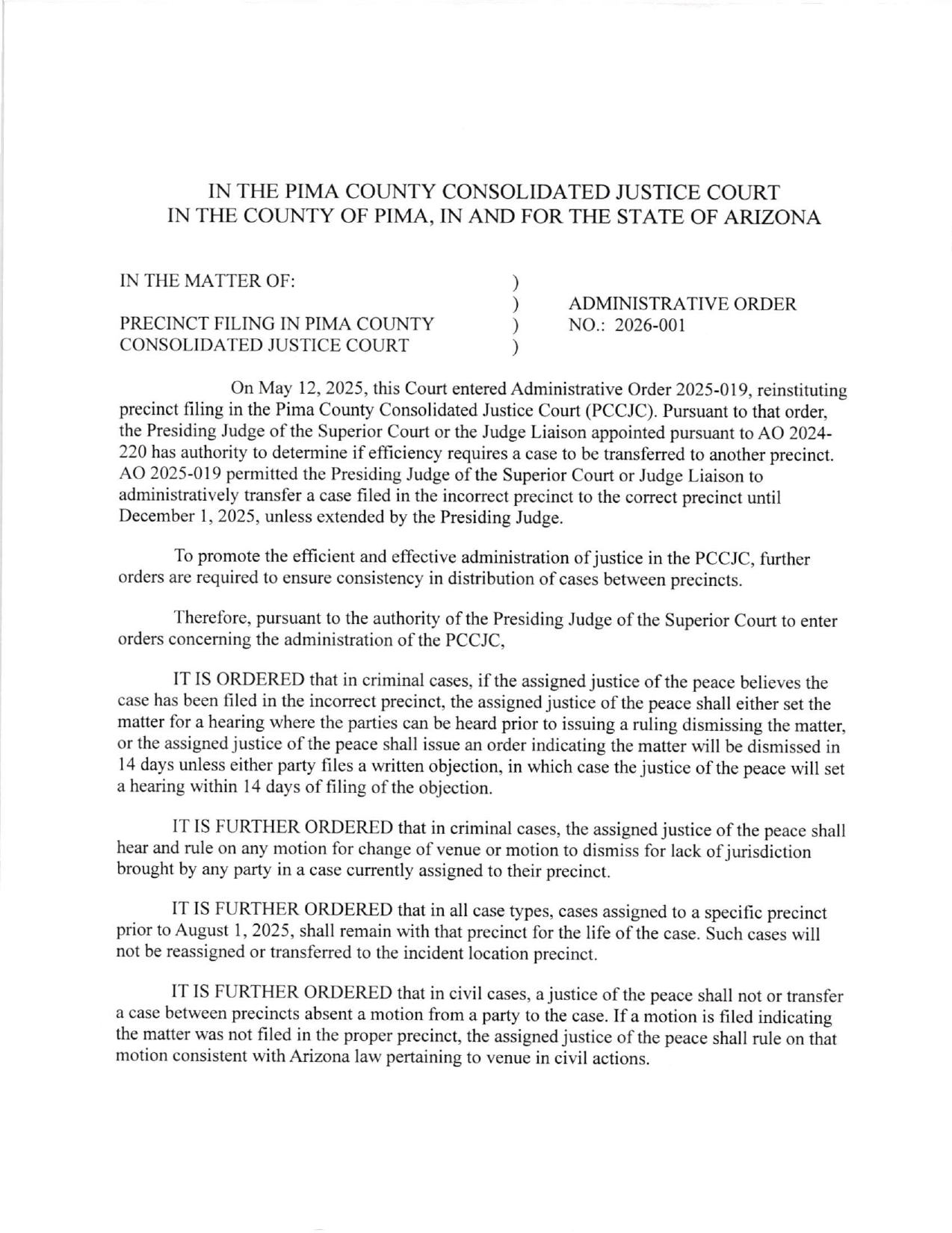
Conclusion
Returns to the central claim that local judicial politics often turns on who gets to define the court in public.
I came to understand the re-precincting controversy as a struggle over truth in institutional form. County administration told one truthful story, but only one: filings had declined, JPCs were below their statutory ceiling, hearing officers and a pro tem carried some categories of work, the election calendar was unforgiving, and the Board possessed real legal authority to redraw precincts. Those were not invented facts. They were part of the truth.
But from chambers I believed there was another truth, equally real and more complete. The court emerging from the pandemic could not be understood by thin public metrics alone. Chambers work, remote hearings, judicial orientation, signature-file review, calendar complexity, programmatic interdependence, transfer burdens, and the democratic significance of precinct office all belonged to the institutional picture. Without them, the county’s public narrative risked converting a constitutional judicial office into an under-described managerial unit. That was why I opposed the proposal as it was then presented, while remaining open in principle to a better-grounded inquiry into future structural reform.
The controversy also taught me that local judicial politics is rarely reducible to a clean conflict between law and politics, or between neutral administration and aggrieved officeholders. It is more unruly than that. The dispute gathered within itself party history, electoral geography, public-record discipline, superior-court supervision, managerial spreadsheets, bench memory, and the practical burdens of running a high-volume non-record court. Maps were part of the argument. So were calendars, key-card logs, caseload tables, election deadlines, former legislators, former supervisors, and the lingering memory of a court already bruised by governance rupture. The politics of court structure lay precisely in that mixture.
For me, then, the episode was never only about JP5, JP6, or even the boundaries of the Pima County Consolidated Justice Court. It was about whether the institutional reality of local justice would be defined from the outside in or described from within in a way adequate to its complexity. It was about whether local judicial independence meant only freedom in particular rulings, or whether it also required some meaningful role in resisting administrative categories that misstate the work of the office. And it was about whether the precinct remained a living public form—territorial, democratic, and juridical—inside a consolidated court that often acted as though territory could be abstracted away.
Time sharpened the point rather than dissolving it. After I left office, the court moved toward a more precinct-specific regime in both filing and jurisdiction. That later turn does not prove that every argument I made in 2021 was correct in every detail. It does, however, show that the territorial question had never truly disappeared. The precinct was not a dead shell. It remained an operative form of legal identity and public administration, even inside a heavily centralized court.
That is why this episode belongs in the scholarship of judicial politics. It shows that the political life of courts is often hidden not in campaign slogans or headline constitutional clashes, but in the management of boundaries, workloads, calendars, and authority. It shows that in lower courts, maps and spreadsheets can function as constitutional instruments in all but name. And it shows that a justice of the peace who is never told how to decide a case may still find the office drawn into a profound struggle over how the institution is measured, narrated, and permitted to endure.
In the end, I did not regard the matter as a mere map fight because it was not one. It was a dispute over the administration of justice in one of its most practical and least romantic forms: who counts the work, who speaks for the court, and who decides whether a community’s judicial office still deserves to stand in the shape the law has given it. If this essay has a larger claim, it is that local courts are remembered or lost at exactly that level. When the work is misdescribed, the office is weakened before it is ever abolished. When the work is rendered visible with enough honesty and institutional care, the law keeps faith not only with doctrine, but with the public world in which doctrine must actually live.
Source Note
This publication edition separates archival evidence, public records, and later scholarly framing so the main essay can read more openly without losing provenance.
Archival core. Chambers memoranda, bench notes, county-facing statements, training materials, spreadsheets, later reports, and the preserved reporter files remain the base record of the essay.
Public-record supplement. Arizona Supreme Court administrative orders, county memoranda, and a small number of public discipline records clarify the larger governance setting.
Documentary method. Claims in the body are still grounded in identified sources; the endnotes now gather provenance so the reading surface can stay more continuous.
Design discipline. Visual materials were limited to one governance timeline, one documentary facsimile, and typographic quote interludes derived from already cited records.
Endnotes
Archival references, public-record supplements, and a limited set of scholarly framing sources for the publication edition.
- Reply to Mr. Huckelberry, 2021-07-28,
- Farewell Address, 2025-04-06,
- Arizona Constitution; A.R.S. 22-101; A.R.S. 22-102; A.R.S. 22-125; AO 2013-70; AO 2020-115; AO 2020-189; AO 2021-105; AO 2024-153; AO 2024-220
- July 27 memo; July 30 memo; September 21 memo
- Gordon Bermant and Russell Wheeler, “Federal Judges and the Judicial Branch: Their Independence and Accountability,” Mercer Law Review 46, no. 2 (1995); Martin H. Redish, “Federal Judicial Independence: Constitutional and Political Perspectives,” Mercer Law Review 46, no. 2 (1995)
History of the Pima County Consolidated Justice Court.docx, file dated 2020-09-21,- Arizona Constitution; A.R.S. 22-101; A.R.S. 22-102; A.R.S. 22-125
- AO 2020-115
History of the Pima County Consolidated Justice Court.docx, file dated 2020-09-21; AO 2020-115- Arizona Daily Star, “Pima County court administrator resigns months after pleading guilty to DUI,” 2020-06-16
- Tim Steller, “Judges question hiring of Pima court official linked to indicted ex-judge,” 2018-09-18; State of Arizona, Commission on Judicial Conduct, Disposition of Complaint 21-290, In the Matter of Keith Bee, Jr.; U.S. Department of Justice, “Former Arizona Judge Sentenced to One Year in Prison for Filing a False Tax Return,” 2022-03-28;
2021.2.8.lr-reprecincting JPs.pdf;2021.3.3.Redistrict JP Precincts 03032021.pdf;2021.6.22.tu.Schedule for Reprecincting JP Precincts.pdf, all attached toJustice Court reprecincting memos, 2021-07-19; July 27 memo; September 21 memo - AZPM, “Live election results: Pima County races,” 2020-11-03; KGUN 9, “Democrat Rex Scott wins tight race for Pima County Supervisor seat,” 2020-11-13; AZPM, “Three Pima supervisors bow out,” 2020-12-16
- Arizona Daily Star / This is Tucson, “Doug Taylor leading Keith Bee II in GOP primary for District 5 JP seat,” 2018-08-29
- ; AO 2016-147; Pima County Justice Court, “Hon. Maria Felix”
- AO 2020-189
- AO 2021-105
First Memo.docx, 2021-01-04,Judge Harrington.docx, 2021-05-07,April 23 Meeting.docx, file dated 2021-05-16,2021.2.8.lr-reprecincting JPs.pdf, attachment circulated by Nicole Fyffe inJustice Court reprecincting memos, 2021-07-192021.4.27.Constables and JP reprecincting.pdf, attachment circulated by Nicole Fyffe inJustice Court reprecincting memos, 2021-07-19June 28, 2021 Bench Meeting.docx, file dated 2021-06-29,Memo Notes.docx, file undated;Memo on Administration.docx, 2021-06-29,Memo on Administration.docx, 2021-06-29,- July 27 memo
- July 27 memo; A.R.S. 22-125
- July 27 memo
- September 21 memo
- Pima County, “About the Court” (Ray Carroll Biography); A.R.S. 22-125;
- July 30 memo; September 21 memo
Paula Aboud- JP6.pdf;First Quarter.docx, 2021-06-20; Paula Ann Aboud, Arizona State Library; September 21 memoMemo on Administration.docx, 2021-06-29,Memo on Administration.docx;Testimony to the Pima County Board of Supervisors.docxMemo to the Board of Supervisors.docx, 2021-09-20,Reply to Mr. Huckelberry.docx, 2021-07-28,- July 27 memo
- State v. Fell, ex rel. Weber;
History of the Pima County Consolidated Justice Court.docx, file dated 2020-09-21, (describing the case as a challenge to PCCJC’s consolidated jurisdiction: Lisabeth Weber was arrested for DUI in Precinct 1; under the master calendar the matter was assigned to Judge Vince Roberts of Precinct 10; Roberts concluded he lacked jurisdiction because the case did not arise in his precinct; the superior court affirmed; and the court of appeals reversed, holding that once assigned, Roberts effectively served as a justice of Precinct 1) 2021.2.8.lr-reprecincting JPs.pdf, attachment circulated by Nicole Fyffe inJustice Court reprecincting memos, 2021-07-19Reply to Mr. Huckelberry.docxApril 23 Meeting.docx;June 28, 2021 Bench Meeting.docx- July 27 memo
All Pending Caseload Summary - February 2022.xlsx;Judicial Monthly Summary - RC CIVIL - February 2022.xlsx;Judicial Monthly Summary - MISDEMEANOR - February 2022.xlsx;Judicial Monthly Summary - DUI - February 2022.xlsx, all in- September 21 memo
Memo on Administration.docxMemo to the Board of Supervisors.docx2021.2.8.lr-reprecincting JPs.pdf;2021.4.27.Constables and JP reprecincting.pdf, both circulated by Nicole Fyffe inJustice Court reprecincting memos, 2021-07-19- July 30 memo; September 21 memo
END OF TERM REPORT.docx, 2025-04-20,- Court Administration notice effective 2025-05-01
- July 30 memo; September 21 memo
Reply to Mr. Huckelberry.docx;April 23 Meeting.docx;June 28, 2021 Bench Meeting.docxFarewell Address.pdf- AO 2020-189; AO 2024-220
- Bermant and Wheeler, Mercer Law Review 46, no. 2; Redish, Mercer Law Review 46, no. 2
Myers Report.pdf, 2025-05-11,Return to Self-Governance.pdf, attachment to email subjectSelf-Governance at the Pima County Consolidated Justice Court, 2023-06-13;2013-70 Presiding JP and CAJP.pdf, attachment to Jeffrey Bergin email same subject, 2023-06-13,- Meet the Judges page
IN THE MATTER OF PRECINCT FILING IN PIMA COUNTY CONSOLIDATED JUSTICE COURT, AO No. 2026-001, 2026-02-04; screenshot of email from Hon. Laine McDonald, subjectprecinct jurisdiction and arraignments, 2026-03-24,- Arizona Supreme Court, 2026 Administrative Orders index; AO 2024-220
Edition Close
This PDF package was prepared as a publication-facing edition of a source-based archival essay. The live source tree, preservation snapshot, staged master, and final researcher release remained untouched during production.
Production files for this edition are stored alongside the essay in the project output directory so the same visual system can be reused for future essays in the series.